
Your curiosity is voracious.
So why is keeping it fed so hard?
To start, rusty, dusty, 'old school' methods slow us down and bore our brains:

Visual Thinking for Learning and Teaching
by Brandy Agerbeck, Loosetooth.com
-
Long lectures that overload anyone's focus
-
Traditional notetaking on 'auditory autopilot'
-
Pages of dense, detailed text lacking big-picture context
-
Desk-bound
all day long
-
Rote memorization without understanding
-
One-size-fits-all approaches
-
High-stakes testing that creates anxiety
-
Scattered, siloed information sources

Your love of learning deserves better tools.
Visual thinking transforms how you capture, organize, and share knowledge—whether you're learning for yourself, teaching others, or preserving important information for the future.
If this sounds like you and your work, you are the kind of visual thinker I call a:
Knowledge Seeker & Lifelong Learner

You are motivated by the pursuit of knowledge and skill building.
You're not just curious. You're the kind of person who's still pulling on threads decades after school stopped requiring it.
What you've always known — and what every traditional learning system seems to forget — is that real understanding isn't transferred. It's *built*. The teacher doesn't pour knowledge into the student. The learner constructs it, piece by piece, in their own head.
The blank page is the construction site.
Visual thinking is the heavy mental lifting equipment.
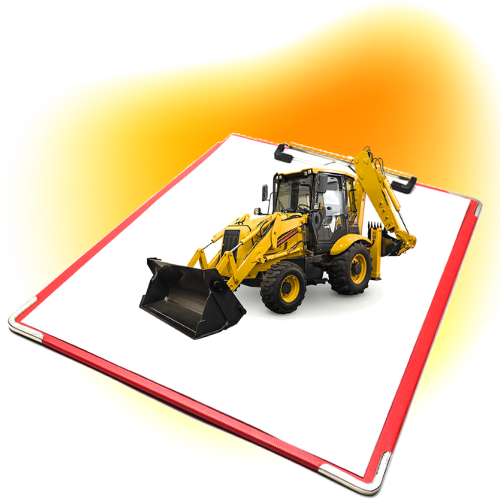
When you draw what you're learning, you're not decorating your notes. You're making the decisions that turn information into understanding — what matters, what connects to what, what shape this idea actually has in your mind.
That's not notetaking. That's thinking on paper.
And once you've thought it on paper, it's yours.
Not memorized.
Built.
When curiosity is on the job, you'll spot a Knowledge Seeker:

Students
boosting focus, retention, and love of learning with hands-on and visual tools
Educators
designing multi-modal learning experiences and integrated curricula
Librarians
guiding curious minds through clearly organized knowledge systems
Learning & Development Professionals
spotting skill gaps, creating strong learning programs, and measuring their impact
Trainers
transforming complex topics, new skills, and mindset shifts into tangible learning experiences that stick


Knowledge Managers
structuring information systems and optimizing organizational knowledge flow
Researchers
designing experiments, visualizing data, and synthesizing disparate findings
Curators
organizing collections and crafting immersive and engaging experiences for public understanding
Autodidacts
developing self-directed learning across multiple fascinations and fields
Historians
tracing connections across time and revealing historical patterns and trends
Documentarians
preserving stories and making intricate narratives accessible and memorable
Why visual thinking and learning fit so well together.
Visual thinking works because it asks the right thing of your brain.
Reading and listening are receiving modes. Information comes at you, and you try to hold onto it. Most of it slips. The harder you try to memorize, the less of it sticks — because memorization isn't understanding.
Memorization is rehearsing the wrapper without ever opening the package.
Drawing flips the dynamic.
The moment you put pen to paper, you stop receiving and start constructing.
*What goes in the center? What branches off? What's the relationship between this and that? Where does this piece fit in the bigger picture?* Each decision is your brain doing the actual work of comprehension — making meaning, not absorbing it.
Three things happen when you learn visually:
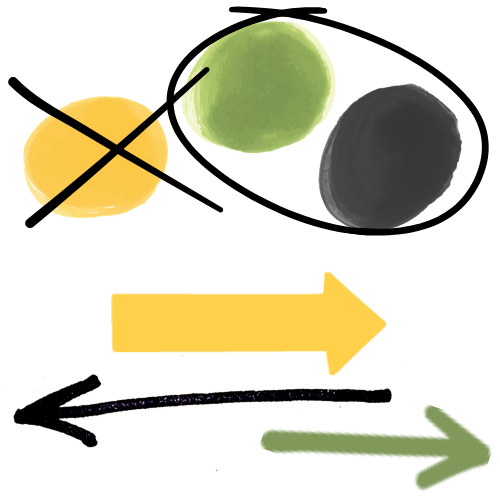
You make decisions.
Every color, every grouping, every arrow is a choice about what matters and how it connects. Your choices are what turn information into understanding.
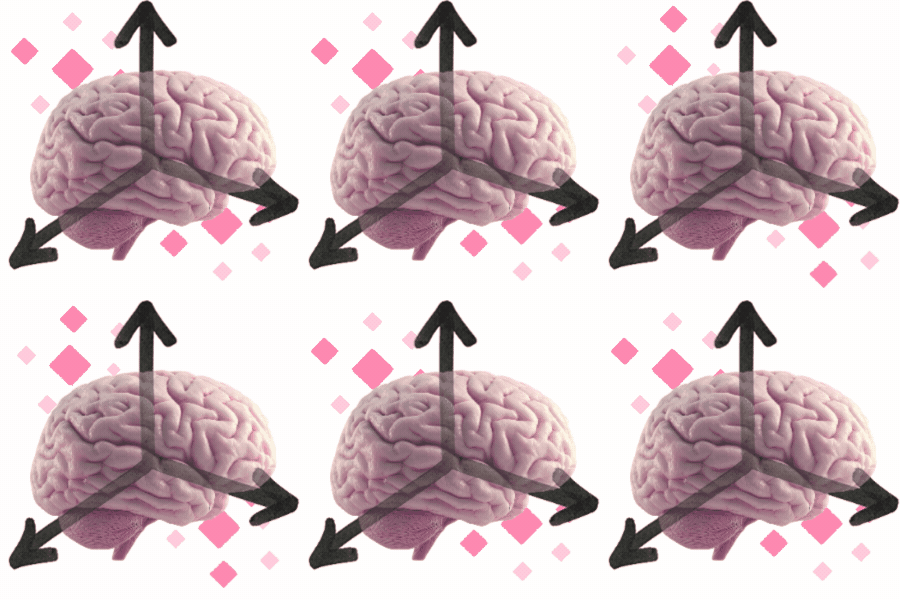
You make it spatial.
Your brain has remarkable spatial memory — You remember where things are. Your way to work, that one passage in that one book. Visual thinking taps into the same system.

You make it yours.
Traditional notes are words on paper. A page of your own visual thinking is a record of how *you* made sense of something. Pick it back up months later and it comes right back to you.
This is why the same Knowledge Seekers who couldn't remember a chapter of textbook reading can recall the diagram they sketched months ago, in detail.
The diagram wasn't busy work.
It was the skill that made learning work.
Hands-on learning through visual thinking tools takes you from cramming to grasping.
Here's how to put lifelong learning at your fingertips:
Visual Thinking 101
One hour. $101. Put this new tool in your hands tonight.
This single-video course teaches you the 9 Elements of Visual Thinking — the building blocks that turn any blank sheet of paper into a focus, learning, and retention tool.
The lowest-cost and fastest way to find out if visual thinking works for your brain. Most learners come out asking, "Where has this been all my life?"
Start the lesson
Want to read more first? Of course you do.

Share Visual Thinking for Learning + Teaching:
Explore more visual thinking for life:
Personal Work + Productivity
Writing + Speaking
Mapping Complex Systems
Learning + Teaching
Facilitation + Collaboration
Site Map | Email policy | Terms + Privacy | © 1998-2026 Brandy Agerbeck, Loosetooth.com
