
You carry the complexity.
Help your team see it clearly.
A team mate groans, "Ugh, why does this have to be all so complicated?"
Your ears perk up. You lean in and start rolling up your sleeves.
You know that 'complicated' really means too many unnecessary parts, but more often people use it to mean complex.
Where other people see a mess, you see a system with moving parts, hidden connections, and layers that matter.
Projects worth their salt are complex. Building and changing systems is complex work.
Worthy work.

Visual Thinking for Mapping Complex Projects and Systems
by Brandy Agerbeck, Loosetooth.com
The problem isn't complexity itself.
The problem is people can't see where they fit.
Why their work matters.

If this sounds like you and your work, you are the kind of visual thinker I call a:
Mess Wrangler & Complexity Tackler
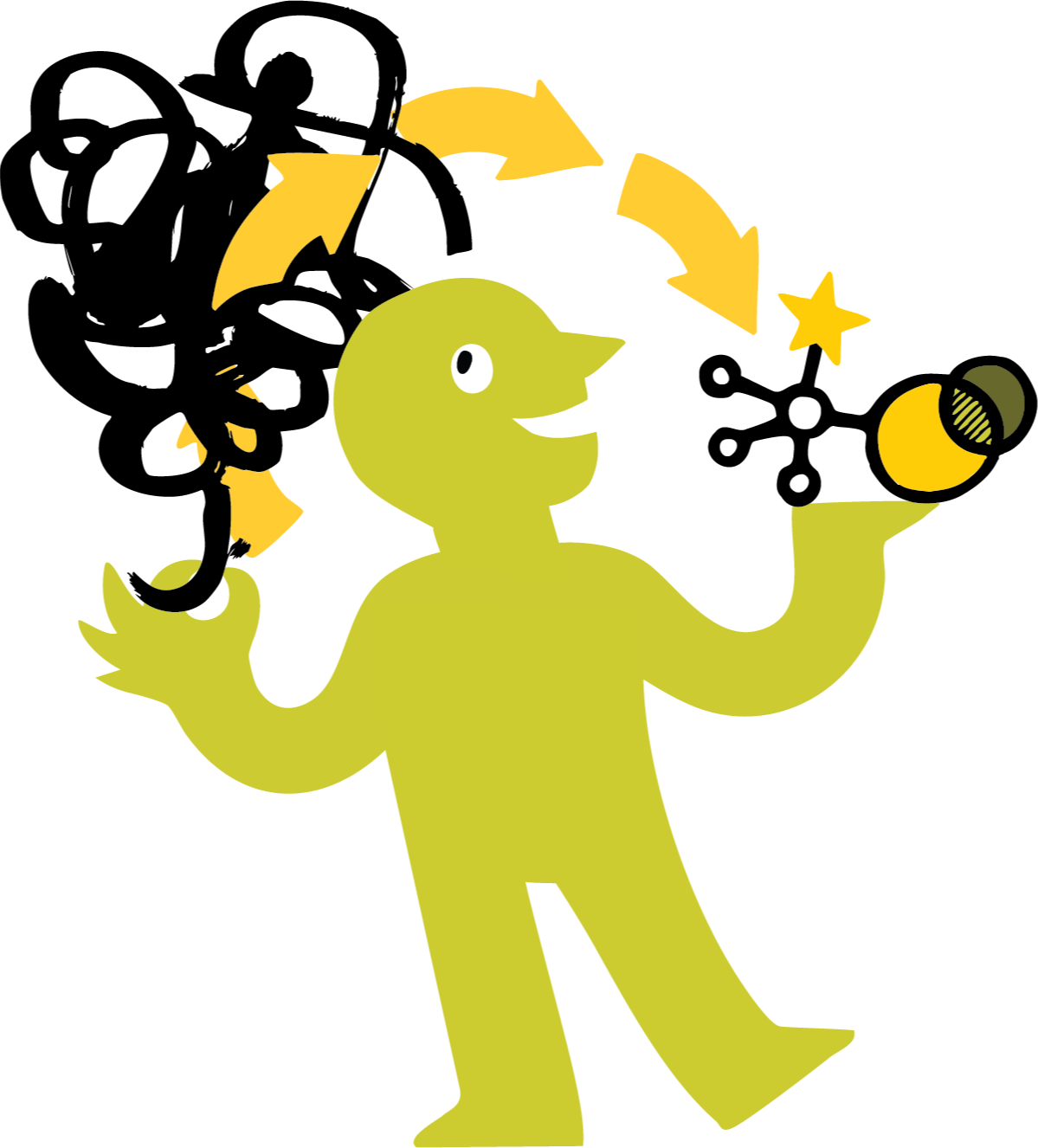
You are motivated by finding clarity within complexity.
You are gutsy, ready to ferret out all the pieces that make up the big picture. And once you have them sorted, visual thinking gives you the vocabulary to express your vision.
A clear set of tools for drawing out the parts, the whole, the connections, the interdependencies — all the invisible architecture of a complex system — in a form other people can finally see and work with
Anywhere a system needs to be seen clearly, there's a Mess Wrangler rolling up their sleeves:
Analysts
seeing patterns and mapping trends across data sources to guide strategy
Business Strategists
decoding market dynamics and competitive landscapes to craft breakthrough strategies
Systems Thinkers
tracking enterprise-wide effects, eyeing what's emerging, and holding the big picture


Project Managers
aligning people, process, and resources to deliver meaningful results on track and on time
Organizational Development Specialists
diagnosing team dynamics and creating healthier workplace cultures
Directors
orchestrating operations and coordinating departments, budgets, and resources
Leaders
navigating teams through uncertainty and aligning efforts to reach shared vision

Agile Practitioners
implementing agile methodologies and driving continuous improvement in team delivery
Scrum Masters
guiding sprint workflows and clearing obstacles for project success
User Experience Professionals
tracing user journeys and building seamless experiences across touchpoints


Engineers
designing complex systems and balancing competing technical constraints
Researchers
investigating complex questions and translating findings into actionable knowledge
You don't just see complexity. You carry it.
You know exactly what drains you:
-
Soundbite culture and the fast fix.
-
Rushing the process because the messy part is too uncomfortable.
-
K.I.S.S. — Keep It Simple, Stupid.
☝️ What's stupid is lopping off parts of the problem and thinking that solves it.
-
When "good enough" will break something downstream.
-
Organizational culture that expects the perfect product pulled from thin air.
And what lights you up:
-
Wading around in the fuzzy front end — getting to know the parts, scope, and constraints.
-
The moment the whole system snaps into view. Chills...
-
Making sure all the pieces truly fit together. Nothing is lost.
-
Getting a room full of people to finally see what you've been seeing.
-
Seeing someone LIGHT UP when they see how their work matters. Their contribution to the solution.
Here's what you already know but might not have language for yet:
Simple isn't possible. Not for the problems worth solving.
But clarity is.
Clarity doesn't mean dumbing it down.
Clarity means:

Making the invisible visible and the abstract concrete.

Structure that holds complexity without flattening it.

A shared picture everyone can point at, question, and build on.
Here is where visual thinking ✨shines.✨
Why is visual thinking the right tool for complex work?
Drawing is writing with more choices.
This isn't writing versus drawing.
They are different cognitive acts.
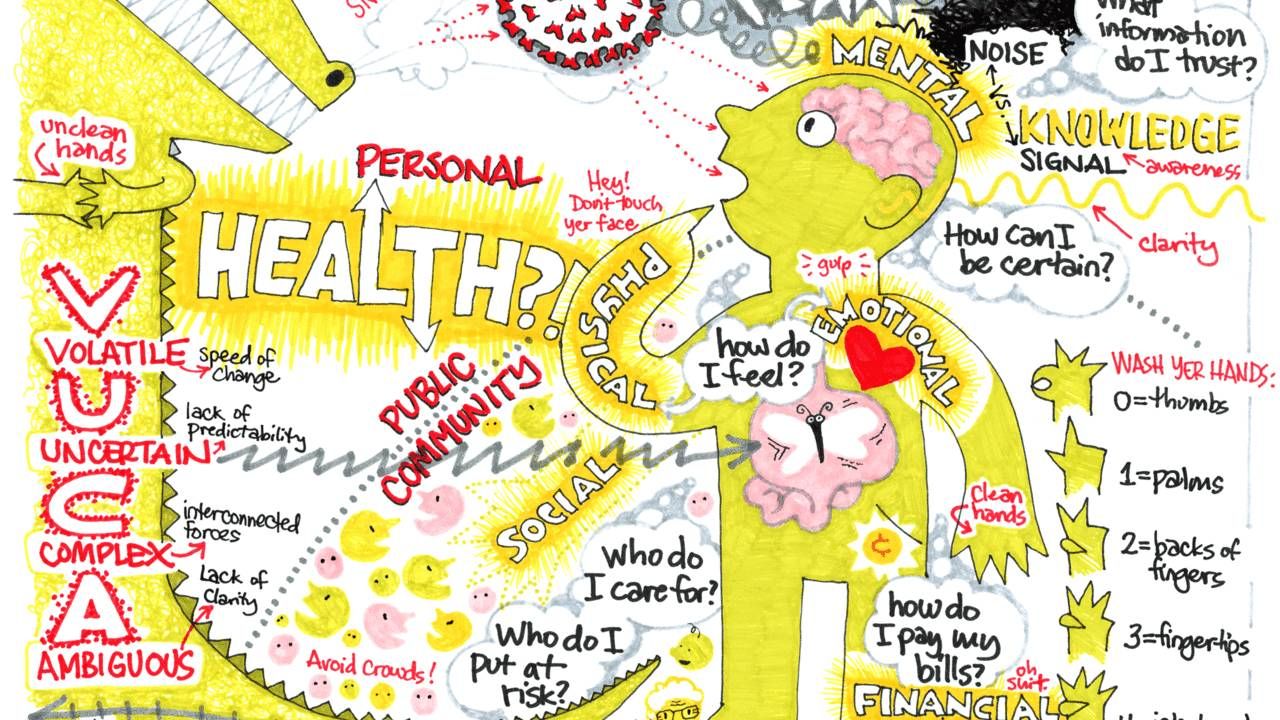
Drawing conveys information that words and bullet points and spreadsheets simply can't.
Seven of those things, in particular, are why every Mess Wrangler should be tackling complexity with paper and pen:
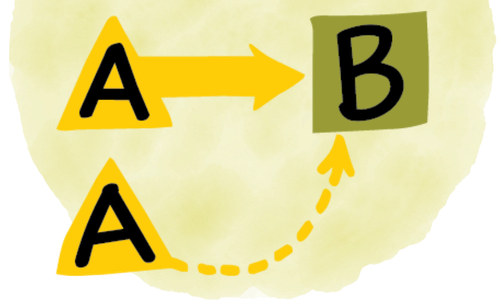
Drawing forces specificity.
You can't sketch a vague relationship. The pen demands you commit — does this lead to that, or merely influence it? Each line is a decision the words let you avoid.
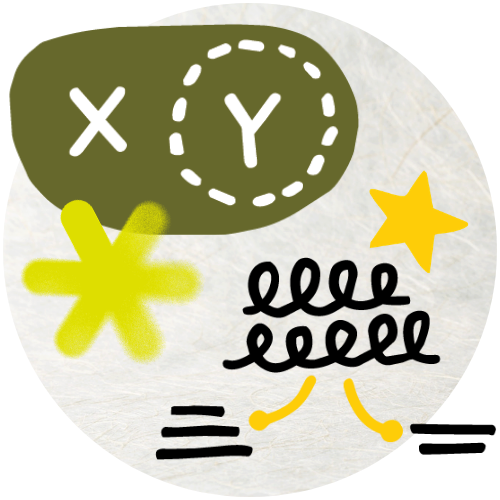
Spatial relationships carry meaning that words can't.
Above and below, near and far, inside and outside — visual position communicates hierarchy, dependency, and proximity in ways no sentence does without paragraphs of qualifiers.

You see the parts and the whole picture at once.
A drawing lets you zoom out to the whole system and zoom in to a single connection without losing your place. That's how complex systems actually work.


Drawing surfaces what you didn't know you knew.
You'll sketch a system and notice a connection you'd never articulated. Or a gap you've been working around without realizing it. The act of drawing pulls tacit knowledge into the open.
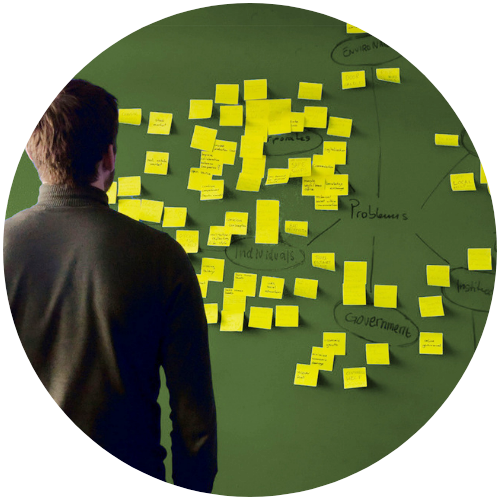
The thinking becomes editable.
Once you make all the pieces tangible, you can interrogate it. Move pieces around. Cross things out. Test alternatives. The drawing is a draft, not a verdict — which is exactly what complexity needs.
Drawings last.
The conversation fades. The whiteboard photo doesn't. Six months later, when someone asks "why did we decide that?" — the drawing remembers what nobody's notes captured.

Drawing together creates shared language and a common vision.
Hand someone your map and they can see what you see — instantly, without 30 minutes of explanation. Then they can question it, correct it, add to it.
The moment your team finally sees the whole picture you've drawn out, the room exhales.
"This is the first time I've felt like we're actually all on the same page."
"Can I show this to my team? They need to see this."
"I never saw how my work connected to theirs until right now. I see where I fit."

"I have to be honest — I had no idea it was this complex. No wonder it kept breaking."
"I've been anxious about this project for months. This map just calmed me down."
"Can I get a copy to put on my wall? I want this in front of me every day."
With visual thinking, drawing out complexity goes from all in your mind's eye to making it clear to everyone.
Ready to get it all mapped out? Here's what I built for brains like yours.
For Individuals
You bring the complexity.
I bring the toolkit.
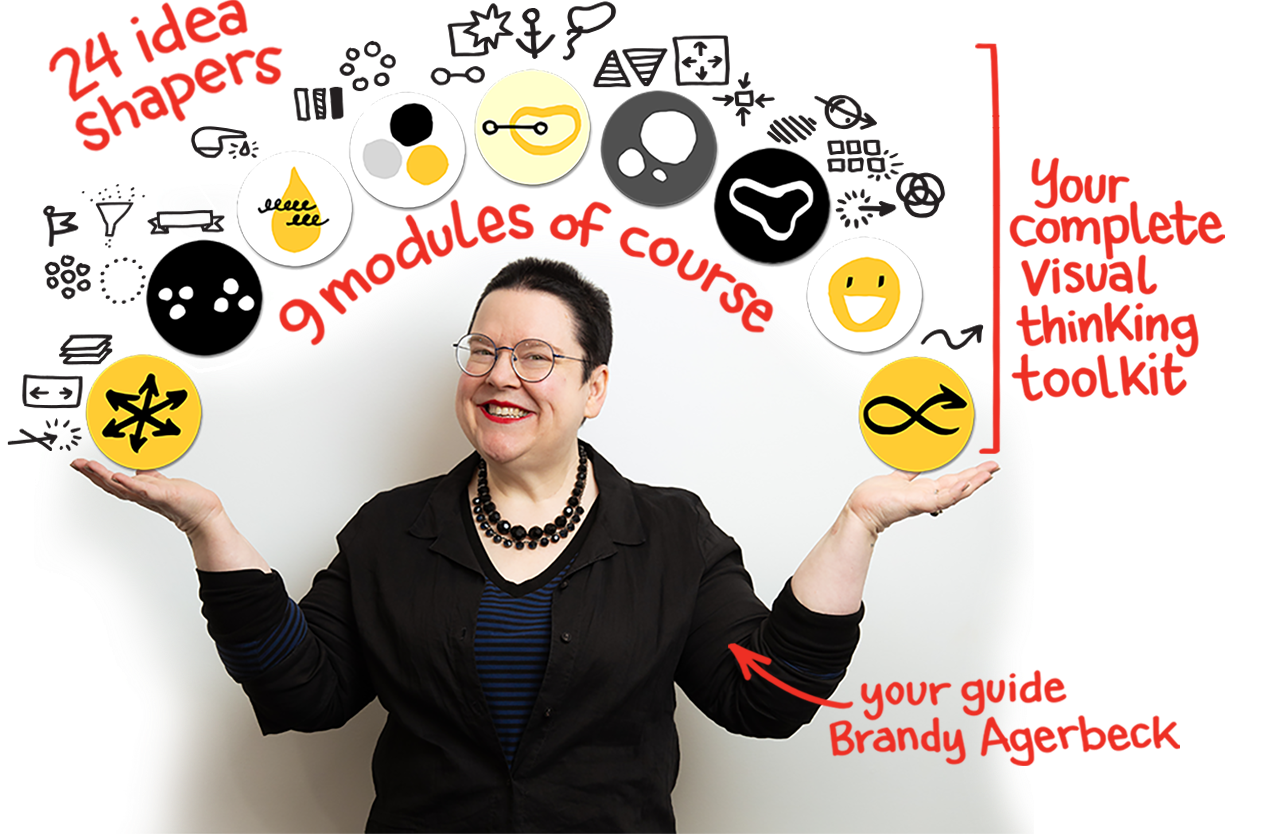
As a fellow Mess Wrangler and Complexity Tackler, I distilled down all of visual thinking's complexity into discreet, concrete techniques.
I call these idea shapers.
My mission was to make each idea shaper so straightforward you think, "Well, duh..."
But together, their sophistication can untangle any system you put in front of them.
You have two formats to learn all 24 idea shapers:
The Book
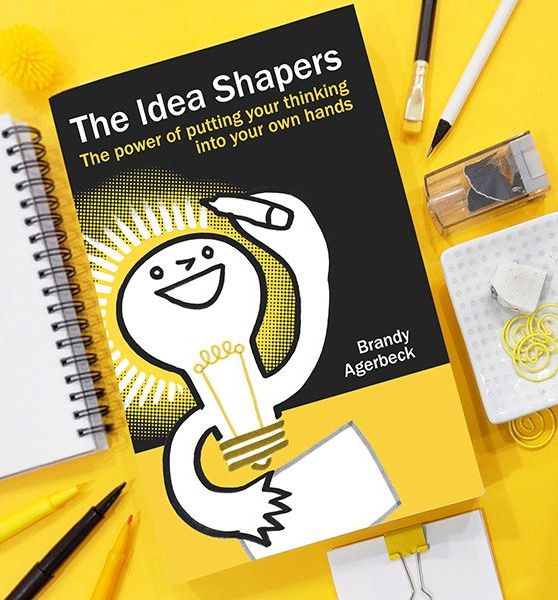
The Idea Shapers
The Idea Shapers is the owner's manual for visual thinking.
All 24 tools, fully documented. For each one — what it is, what it's built for, and your various and nuanced choices. Every chapter ends with the idea shaper brought to life with a story of it 'at work.'
Dense, durable, and built to be used. Keep it within arm's reach for reference on your desk or work table.
Pull it out when you're stuck, find the tool that fits, get back to work.
Get the bookThe Course
The Agerbeck Method
The Agerbeck Method is operator training for the toolkit.
Going beyond what I can do in the pages of the book, I demonstrate every idea shaper through bite-sized videos. Practice exercises with every lesson. Delivered in the sequence that lets you just log in, press play, and leave fully equipped.
9 modules. 90 short video lessons. By the end, visual thinking isn't a thing you reach for. It's a thing you do.
Begin the course in minutes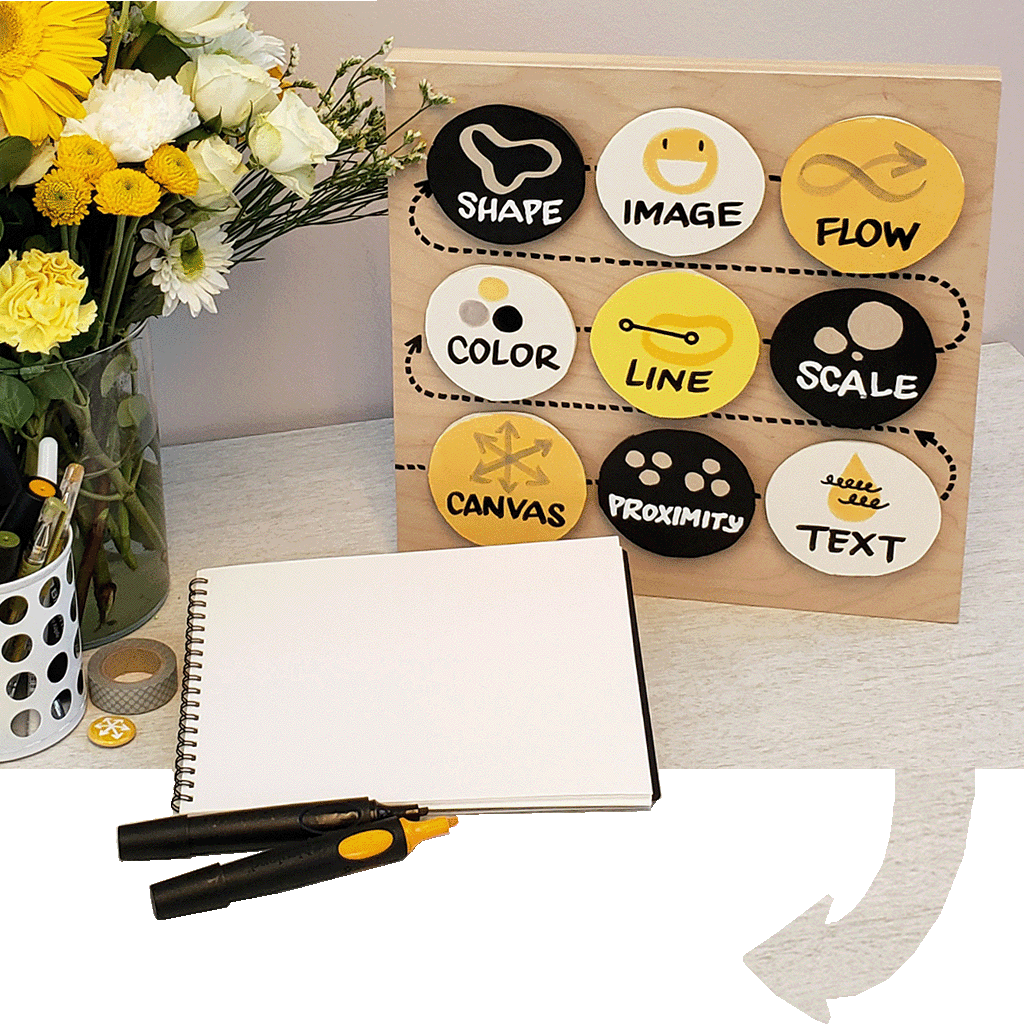
p.s. When you register, you'll see a choice between Agerbeck Method SOLO or STUDIO.
If you're a self-paced superstar, SOLO will suit you. Need live sessions and folks alongside you? STUDIO adds the year-round community — module calls and monthly deliberate practice by my side.

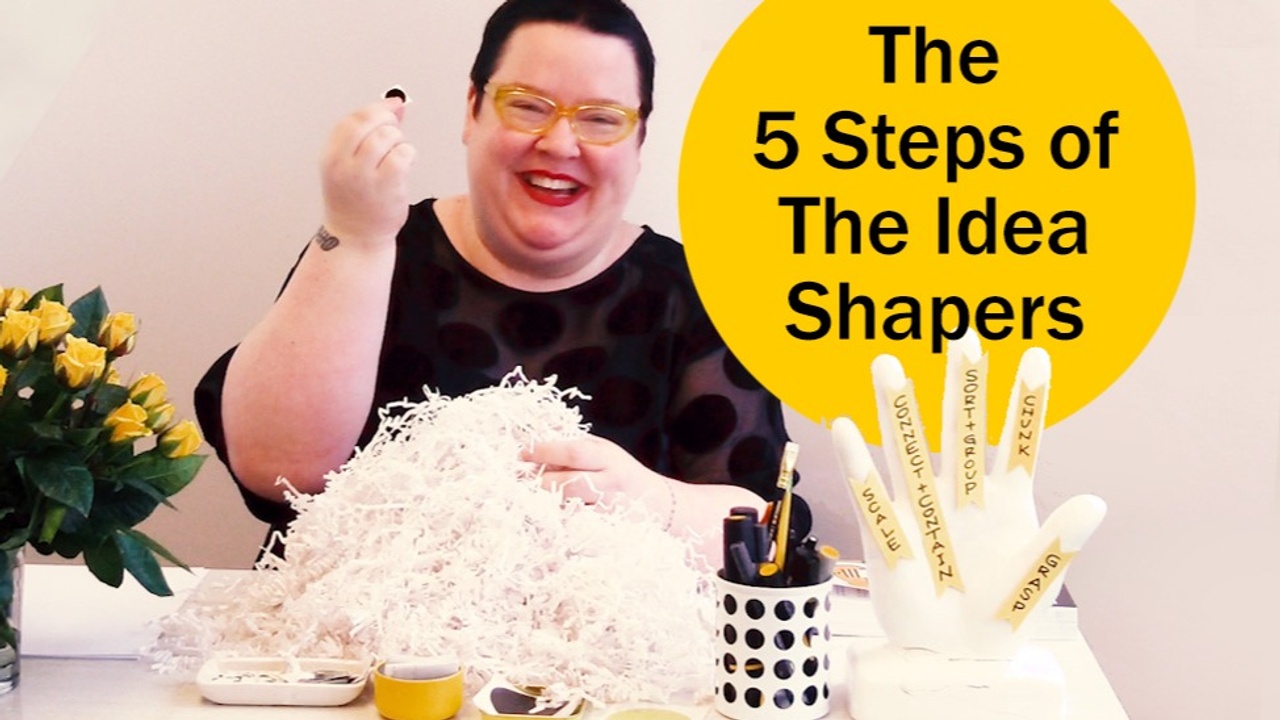
Want to vet the thinking first? Smart. Start here.
For Organizations
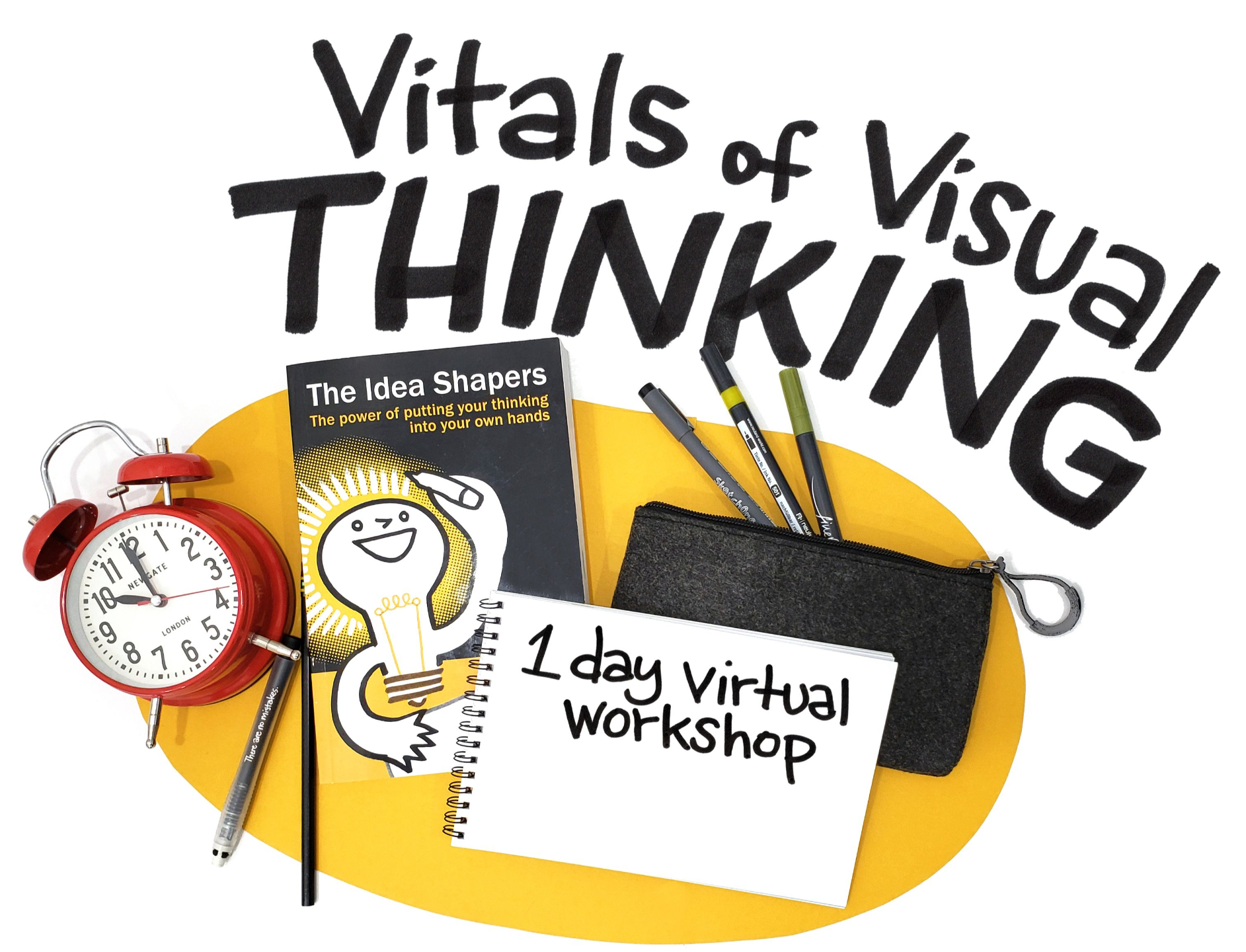
p.s. Post-workshop, your most fired-up participants can take The Agerbeck Method together as a cohort to go deeper and bring their visual thinking skills into the organization.
Share Visual Thinking for Mapping Complex Systems:
Explore more visual thinking for life:
Personal Work + Productivity
Writing + Speaking
Mapping Complex Systems
Learning + Teaching
Facilitation + Collaboration
Site Map | Email policy | Terms + Privacy | © 1998-2026 Brandy Agerbeck, Loosetooth.com
